How PostgreSQL tells every connection its cache is stale
Each PostgreSQL connection caches the catalog for itself. How a change is announced to all of them at commit through a shared ring, and what happens to a connection that falls behind.
Contents
What happened
I once worked on a cache that sat in front of a database. It answered quickly and sometimes wrongly.
I redesigned it as three isolated segments with version-based invalidation. Each entry remembers the version of the data it came from, and once the data has a newer version, the old entry stops counting. The hit rate went from 84.3% to 98.1%, and the database answered about 131 million fewer queries a week.
Looking back, storing things was the easy part of that cache. Most of the effort went into deciding when to throw an entry away.
Later, when I started reading PostgreSQL’s source, I found the same problem inside every connection.
Each PostgreSQL connection keeps its own copy of the catalog. A change is announced at commit through one shared ring of messages, and each connection reads the ring before it trusts its copy.
Why every connection keeps its own cache
Think of a library where every reader keeps a notebook of the facts they look up often, so they don’t have to walk back to the shelves each time. PostgreSQL connections work the same way.
Each connection gets its own server process, a backend, with private memory. What the database knows about itself is in the system catalog, a set of ordinary tables. pg_class has a row per table, index or view, and pg_attribute has a row per column.
To run even SELECT * FROM orders, a backend has to know what orders is: its columns, their types, its indexes. It could read all of that from the catalog tables for every query, but that would be far too slow.
Instead, each backend keeps three caches of its own:
- the catalog cache (catcache) holds single catalog rows looked up by key, such as “the
pg_classrow of table 16384”. Most code gets to it through a layer called the syscache. - the relation cache (relcache) holds one assembled description per table or index, with everything needed to open it.
- the plan cache holds the saved plans of prepared statements, which depend on the tables they read.
None of this is shared. When one connection changes the catalog, every other connection’s caches are wrong, and nothing has told them yet.
Collecting changes until commit
When a backend inserts, updates or deletes a catalog row, it doesn’t flush anything straight away. Under PostgreSQL’s rules, the old row stays valid until the current command ends.
What the backend does instead is record an invalidation message for each cache that could hold the row. It keeps that list until the change is final.
An update counts as a delete plus an insert, and the two fold into one message when the cache’s key didn’t change. A change to a row of pg_class, pg_attribute or pg_index, or to a foreign key’s row in pg_constraint, also records a relcache message for the table that row describes. A table gets at most one of those per command.
What happens to the list depends on how things end:
- A command ends. The backend applies that command’s messages to its own caches and nobody else’s (CommandEndInvalidationMessages). That’s why your next statement already sees the column you added. Other backends can’t see your uncommitted rows, so there’s nothing to tell them.
- The transaction commits. The commit is recorded first, then every message goes into the shared queue (AtEOXact_Inval), and only after that are the locks released.
- The transaction aborts. Nothing is sent, and the backend undoes its own cache changes. An aborted subtransaction does the same for its part, and a committed one hands its list to its parent.
The order at commit protects both sides. If the messages went out before the commit was recorded, another backend could reload the catalog and still find the old rows. If they went out after the locks were released, a backend waiting for the table could get them only after it had used its stale entry.
The commit’s WAL record carries the same messages, so a standby replays them for its own connections.
The ring of messages
The messages go into the shared invalidation queue, sinval for short, in shared memory. There’s one for the whole server, covering every database. Each message carries a database id, and a backend skips messages for other databases.
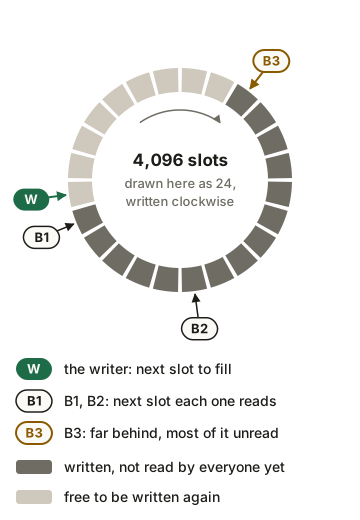
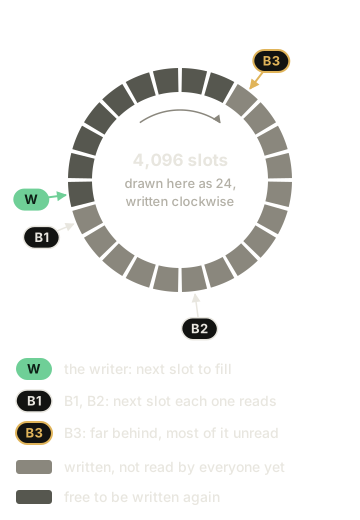
The code describes it as an infinite list of numbered messages. In memory it’s a ring of 4,096 slots (MAXNUMMESSAGES), and message n sits in slot n modulo 4,096. A message is 16 bytes, so the whole ring is about 64 KB.
Three numbers keep track of it:
maxMsgNum, the write position, where the next message goes;nextMsgNum, one per backend, the next message that backend hasn’t read;minMsgNum, the oldest message anyone still needs.
A new connection starts with its read position at the write position. Its caches are empty, so it has nothing to catch up on.
The main kinds of message are:
- catcache: rows with this hash may be stale in this cache;
- catalog: forget everything cached from this whole catalog;
- relcache: this table’s description is stale, or every table’s when the id is 0;
- smgr: close your file handles for this table; this kind is never skipped by database;
- relmap and snapshot: smaller kinds, for the map of a few catalogs’ files and for the snapshot used to read the catalog.
A catcache message doesn’t carry the key, only a hash of it, because a table name wouldn’t fit in 16 bytes. The receiver removes every entry in that cache with the same hash. Once in a while that catches an unrelated row whose key hashes the same, a false positive that costs one reload.
Writers add messages under a lock, at most 64 at a time (SIInsertDataEntries), so even a commit with thousands of messages never holds the lock for long. After each chunk, the writer sets a “you have messages” flag on every backend.
Reading the ring before trusting the cache
A backend has to read the ring before it trusts its caches.
Reading the ring is one function, AcceptInvalidationMessages() (inval.c:929). It calls ReceiveSharedInvalidMessages, which pulls messages 32 at a time from SIGetDataEntries and applies each one to the local caches.
A backend reads the ring at two moments:
- when a transaction starts, so every transaction begins with checked caches;
- when it locks a table it did not already hold in that mode, in LockRelationOid and its siblings in
lmgr.c.
ALTER TABLE ... ADD COLUMN shows why the second one matters. It takes an ACCESS EXCLUSIVE lock, and the committing backend writes its messages before it lets go of that lock.
Whoever gets a lock on the table next reads the ring right after, and finds the messages already there. Once a backend holds the lock, it can trust its cache for that table.
If the backend already held that kind of lock, it skips the read. Nobody could have changed the table in a conflicting way while it held the lock.
Usually there’s nothing new, and the read costs almost nothing. SIGetDataEntries first looks at the backend’s own “has messages” flag without taking a lock, and returns at once when the flag isn’t set.
When there are messages, each one is applied in turn:
- A catcache message removes the matching rows, plus every cached list in that cache. A row in use at that moment is marked dead, and removed once it’s released.
- A relcache message drops the table’s description if nobody has it open, and rebuilds it if someone does.
- Each message also runs the callbacks registered for it. The plan cache registers some, so a relcache message marks every saved plan that reads the table as invalid. The plan is built again the next time it’s used.
Within one transaction’s messages, the catcache ones come first. That way a table’s description is never rebuilt from catalog rows that are about to be thrown away.
When the ring fills up
A writer never waits for a slow reader, or one idle connection could hold up every DDL on the server. Instead, PostgreSQL cleans up the ring and nudges the reader furthest behind. A reader that falls too far behind gets reset.
Cleanup (SICleanupQueue) runs when the ring holds 2,048 messages, again every 256 after that, and whenever a write would not fit. It does three things:
- It finds the oldest message anyone still needs, which frees the slots before it.
- It marks for reset any backend so far behind that the writer is about to overwrite a message it hasn’t read.
- It signals at most one backend: of those more than 2,048 messages behind and not yet signalled, the one furthest behind. The signal asks it to catch up.
flowchart TD
  W["A commit writes messages"] --> Q{"Past the cleanup threshold<br/>(2,048, then every 256),<br/>or no room left?"}
  Q -->|no| G["Write them and go on"]
  Q -->|yes| C["Clean up the ring"]
  C --> L{"Is a reader about to lose<br/>a message it has not read?"}
  L -->|yes| R["Mark it for reset: at its next<br/>read it drops its whole cache"]
  R --> S{"Any reader over 2,048 behind<br/>and not yet signalled?"}
  L -->|no| S
  S -->|no| G
  S -->|yes| N["Signal the one furthest behind"]
  N --> G
  N -.-> K["The reader catches up<br/>while waiting for its client"]
  K -.-> P["Then it runs cleanup itself"]
  P -.->|signal passes on| S
The signalled backend deals with it while it waits for its client. If it’s inside an open transaction, it calls AcceptInvalidationMessages(). If not, it starts and commits an empty transaction, which reads the ring on the way in.
Once it has caught up, it runs cleanup itself, and that cleanup signals the next backend furthest behind. The source calls this a daisy chain. Usually only one signal is in flight at a time, so idle connections wake one after another and not all at once.
A reader that stays stuck after its signal is passed over. Later cleanups signal the next reader that hasn’t had one.
The last resort is the reset. A backend whose unread message has been overwritten can’t know what that message said. The only safe thing is to throw away its whole cache and reload entries from the catalog as they’re needed.
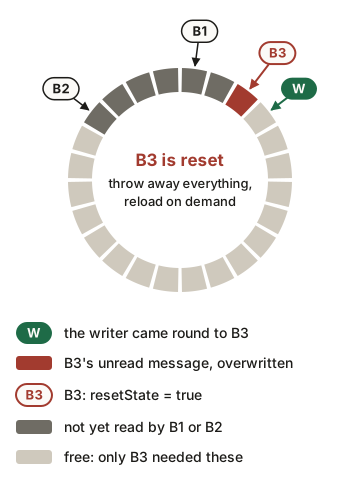
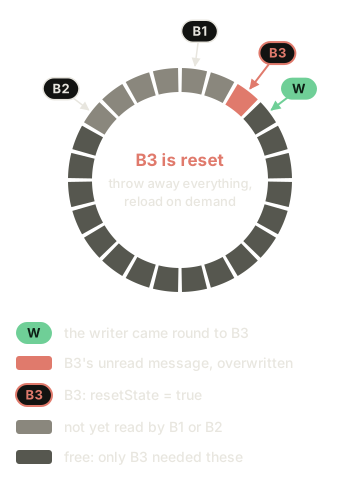
At its next read, a backend marked for reset gets no messages. It jumps to the write position and resets instead, through InvalidateSystemCachesExtended:
- every catalog cache is emptied;
- every table description nobody has open is dropped, and the open ones are rebuilt;
- every catcache callback runs with hash 0, and every relcache callback with
InvalidOid, both meaning “everything”.
A reset is always correct, but for a while it’s slow. Every lookup in that connection goes back to the catalog tables until the caches fill up again.
Keeping your own cache honest
An extension may keep a cache of its own, with things like options worked out for a table, a parsed setting or a connection to another server. PostgreSQL doesn’t know about that cache, so it can’t flush it, but you can register a function for it to call when it applies a message.
CacheRegisterSyscacheCallback(cacheid, func, arg)(inval.c:1815) runsfuncfor each catcache message for that cache, with the hash.CacheRegisterRelcacheCallback(func, arg)(inval.c:1857) runsfuncfor each relcache message, with the table’s OID.
- Register once per backend. There’s no function to unregister. The slots are fixed: 64 catcache callbacks and 10 relcache callbacks per backend, shared with PostgreSQL’s own caches and every other extension that’s loaded. Running out is
FATAL, and the connection ends. - Treat 0 and
InvalidOidas “drop everything”. That’s what a reset sends. - In the callback, only mark entries stale. Don’t read the catalogs there; rebuild on the next lookup. The callback runs whenever the backend reads the ring, and that can be in the middle of your own catalog read.
- A catcache callback gets a hash, not a key. Store each key’s hash when you build an entry, or flush everything for that cache.
- Watch for entries born stale. Building an entry reads the catalogs, reading takes locks, and a lock reads the ring. That can run your callback for the very entry you’re building. PostgreSQL’s relcache builds again when that happens; most other caches rely on DDL taking an
ACCESS EXCLUSIVElock.
The sketch below shows the pattern. The my_ names are made up, and I haven’t compiled this exact code.
typedef struct MyEntry{    Oid     relid;          /* hash key: the table */    bool    valid;    int     setting;        /* worked out from the catalogs */} MyEntry;
static HTAB *my_cache = NULL;static uint64 my_inval_count = 0;
static voidmy_relcache_callback(Datum arg, Oid relid){    HASH_SEQ_STATUS status;    MyEntry    *entry;
    my_inval_count++;    if (relid == InvalidOid)    /* a reset: anything may be stale */    {        hash_seq_init(&status, my_cache);        while ((entry = hash_seq_search(&status)) != NULL)            entry->valid = false;    }    else if ((entry = hash_search(my_cache, &relid, HASH_FIND, NULL)) != NULL)        entry->valid = false;   /* only mark it: no catalog reads here */}
static MyEntry *my_lookup(Oid relid){    MyEntry    *entry;    bool        found;
    if (my_cache == NULL)    {        HASHCTL ctl = {.keysize = sizeof(Oid), .entrysize = sizeof(MyEntry)};
        my_cache = hash_create("my cache", 64, &ctl, HASH_ELEM | HASH_BLOBS);        CacheRegisterRelcacheCallback(my_relcache_callback, (Datum) 0);    }
    entry = hash_search(my_cache, &relid, HASH_ENTER, &found);    if (!found)        entry->valid = false;
    while (!entry->valid)    {        uint64  before = my_inval_count;
        entry->setting = my_compute_setting(relid);  /* reads the catalogs */        entry->valid = (my_inval_count == before);    }    return entry;}
The counter guards against an entry born stale: if any callback ran during the build, the loop builds it again. If the build fails with an error, the entry stays invalid and the next lookup tries again.
postgres_fdw is a real example. Its connection cache registers catcache callbacks for pg_foreign_server and pg_user_mapping once, when it creates its hash table. Each connection it opens remembers the hash of its server’s key and of its user mapping’s key.
Its callback (connection.c:1295) treats hash 0 as “all”, and otherwise compares hashes.
A connection not used in the current transaction is closed at once. A connection in use is only marked, and closed when the transaction ends, because you can’t pull a connection out from under a running query.
Another cache in the same extension, the one that remembers which objects are safe to send to the remote server, does the simple thing. It empties itself whenever a foreign server’s row changes (shippable.c:64).
A worked example: one ALTER TABLE
Take two connections to the same database. Session B has been using orders:
PREPARE get_order(int) AS SELECT id, total FROM orders WHERE id = $1;EXECUTE get_order(7);B now holds the pg_class row of orders, a relcache entry for it, and a saved plan for get_order.
ALTER TABLE orders ADD COLUMN discount integer;- A takes an
ACCESS EXCLUSIVElock onorders. If B were inside a transaction that had readorders, A would wait here until it ended. - A inserts a
pg_attributerow fordiscount.pg_attributehas two caches, by column name and by column number, so that’s two catcache messages. The row belongs toorders, so there’s one relcache message too. - A updates the
pg_classrow oforders, whose column count goes up by one.pg_classhas two caches, by OID and by name. Neither key changed, so that’s one message each, andordersalready has its relcache message. - A ends an internal command and applies the messages to its own caches. The rest of the statement sees the new column.
- A commits. The commit is recorded, the messages go into the ring, and the lock is released.
| # | Kind | Cache or table | Why |
|---|---|---|---|
| 1 | catcache | pg_attribute by name |
the new column’s row |
| 2 | catcache | pg_attribute by number |
the same row |
| 3 | catcache | pg_class by OID |
the column count changed |
| 4 | catcache | pg_class by name |
the same row |
| 5 | relcache | orders |
its rows changed; listed once |
By my reading of the source, five is the floor. A default, a constraint or an index touches rows in more catalogs, and each of those rows brings its own messages. I’d rather give you the kinds than a total I can’t defend.
Then B runs EXECUTE get_order(7);:
- B starts a transaction and reads the ring, which now holds A’s messages.
- The
pg_classmessages remove B’s cached row oforders. Thepg_attributemessages name the new column, which B never cached. B’s rows for the old columns didn’t change, so they stay. - The relcache message drops B’s description of
orders, which nobody has open between transactions. The plan cache’s callback marksget_orderinvalid. EXECUTEfinds the plan invalid. It locksorders, reads the ring again and finds nothing new, reloadsordersfrom the catalog, and plans again.- B gets the same two columns, and it never runs the old plan against the changed table.
The same steps as a sequence diagram. In it, B reads the ring when it takes its lock; in a new transaction it has already read it once at the start.
sequenceDiagram
  participant A as Session A
  participant R as Shared ring
  participant B as Session B
  participant C as Catalog
  A->>C: ALTER TABLE orders ADD COLUMN discount
  Note over A: holds ACCESS EXCLUSIVE on orders
  A->>C: commit recorded
  A->>R: invalidation messages written
  Note over A: locks released
  B->>B: next query on orders
  B->>B: lock on orders
  B->>R: AcceptInvalidationMessages()
  R-->>B: the messages from A
  B->>B: stale entries for orders dropped
  B->>C: reload orders
  C-->>B: orders, now with discount
Gotchas
-
A catcache message carries a hash, not a key. Unrelated rows with the same hash are flushed too, which costs a reload and nothing else. Your own catcache callback gets the hash and no OID, so compare stored hashes or flush everything.
-
Any message to a cache drops every list in it. Some lookups ask a cache for all rows that match part of a key, and the answer is cached as a list; finding functions by name works this way. A list can’t be checked against one hash, so it goes. A burst of
CREATE OR REPLACE FUNCTIONempties those lists in every connection. -
An idle connection lags. It reads the ring at its next transaction or new lock, or when it’s the one signalled. It acts on a signal only while it waits for its client, so a connection busy with one long query reads the ring only when it takes a new lock.
-
One huge DDL can reset many connections at once. Dropping a schema full of tables changes thousands of catalog rows, and the commit sends all their messages together. Connections that haven’t read along by the time the writer comes round can be reset, and then they all reload their caches at about the same time.
-
debug_discard_cachesworks only in assert builds. It throws caches away at every chance, to catch code that holds on to an entry too long. At 1, the regression tests run about 100 times slower. It works in builds with assertions, or withDISCARD_CACHES_ENABLEDdefined; anywhere else it stays 0, and setting it to anything else fails. -
A prepared
SELECT *fails afterADD COLUMN, on purpose. The new plan would return one more column, and PostgreSQL won’t change a prepared statement’s result shape. Name the columns, or prepare the statement again.ERROR: cached plan must not change result type
The whole loop in one picture
session A, the writer  change a catalog row    -> one message per cache that could hold it  end of each command    -> apply them to A's own caches  COMMIT recorded    -> all messages into the ring    -> locks released
the ring: one per server, 4,096 slots  one write position  one read position per backend
session B, a reader  transaction start, or a new lock    -> read the ring    -> drop stale rows, descriptions, plans  next use    -> reload from the catalog tables
ring too full  -> signal the furthest-behind reader not yet signalled  -> a full ring behind: reset, reload all
Why this matters
If you write an extension, PostgreSQL can’t see any cache you keep, so follow the five rules in Keeping your own cache honest.
If you run many connections, each one keeps its own caches and pays for its own reloads. After a wave of resets, every one of them reads the same catalog rows again.
Huge catalog changes go down better at quiet times, or split into smaller transactions, so connections get a chance to catch up between commits. A connection pooler helps as well, since fewer backends means fewer caches to keep up to date.
Dig deeper
The long comment that opens inval.c is the best explanation of all this that I know. sinvaladt.c opens with the design of the ring. Both links, and every trail below, are at PostgreSQL 18.3.
Code trail From a commit to the next query
-
CommandEndInvalidationMessagesinval.c:1408if (transInvalInfo == NULL)return;ProcessInvalidationMessages(&transInvalInfo->ii.CurrentCmdInvalidMsgs,LocalExecuteInvalidationMessage);/* WAL Log per-command invalidation messages for wal_level=logical */if (XLogLogicalInfoActive())LogLogicalInvalidations();AppendInvalidationMessages(&transInvalInfo->PriorCmdInvalidMsgs,&transInvalInfo->ii.CurrentCmdInvalidMsgs);inval.c, lines 1416–1427 at REL_18_3
At the end of each command, the backend applies that command’s messages to its own caches only. Nothing reaches the ring yet.
-
CommitTransactionxact.c:2227* Make catalog changes visible to all backends. This has to happen after* relcache references are dropped (see comments for* AtEOXact_RelationCache), but before locks are released (if anyone is* waiting for lock on a relation we've modified, we want them to know* about the catalog change before they start using the relation).*/AtEOXact_Inval(true);AtEOXact_MultiXact();ResourceOwnerRelease(TopTransactionResourceOwner,RESOURCE_RELEASE_LOCKS,xact.c, lines 2427–2438 at REL_18_3
After the commit is recorded (
RecordTransactionCommit, earlier in this function), the messages go out, and the comment explains why this happens before the locks are released. -
AtEOXact_Invalinval.c:1198AppendInvalidationMessages(&transInvalInfo->PriorCmdInvalidMsgs,&transInvalInfo->ii.CurrentCmdInvalidMsgs);ProcessInvalidationMessagesMulti(&transInvalInfo->PriorCmdInvalidMsgs,SendSharedInvalidMessages);if (transInvalInfo->ii.RelcacheInitFileInval)RelationCacheInitFilePostInvalidate();}else{ProcessInvalidationMessages(&transInvalInfo->PriorCmdInvalidMsgs,LocalExecuteInvalidationMessage);inval.c, lines 1222–1234 at REL_18_3
On commit, every message goes to the shared ring. On abort, the
elsebranch only undoes this backend’s own caches. -
SIInsertDataEntriessinvaladt.c:369* If the buffer is full, we *must* acquire some space. Clean the* queue and reset anyone who is preventing space from being freed.* Otherwise, clean the queue only when it's exceeded the next* fullness threshold. We have to loop and recheck the buffer state* after any call of SICleanupQueue.*/for (;;){numMsgs = segP->maxMsgNum - segP->minMsgNum;if (numMsgs + nthistime > MAXNUMMESSAGES ||numMsgs >= segP->nextThreshold)SICleanupQueue(true, nthistime);elsebreak;sinvaladt.c, lines 395–408 at REL_18_3
Before each chunk of at most 64 messages, the writer cleans the ring if it is full or past its next threshold.
-
AtStart_Cachexact.c:1166static voidAtStart_Cache(void){AcceptInvalidationMessages();}xact.c, lines 1166–1170 at REL_18_3
Every transaction starts by reading the ring. This is the whole function.
-
LockRelationOidlmgr.c:106* Now that we have the lock, check for invalidation messages, so that we* will update or flush any stale relcache entry before we try to use it.* RangeVarGetRelid() specifically relies on us for this. We can skip* this in the not-uncommon case that we already had the same type of lock* being requested, since then no one else could have modified the* relcache entry in an undesirable way. (In the case where our own xact* modifies the rel, the relcache update happens via* CommandCounterIncrement, not here.)** However, in corner cases where code acts on tables (usually catalogs)* recursively, we might get here while still processing invalidation* messages in some outer execution of this function or a sibling. The* "cleared" status of the lock tells us whether we really are done* absorbing relevant inval messages.*/if (res != LOCKACQUIRE_ALREADY_CLEAR){AcceptInvalidationMessages();MarkLockClear(locallock);lmgr.c, lines 119–137 at REL_18_3
The other moment: right after a lock on a table is granted, unless the backend already held one like it.
-
AcceptInvalidationMessagesinval.c:929ReceiveSharedInvalidMessages(LocalExecuteInvalidationMessage,InvalidateSystemCaches);/*----------* Test code to force cache flushes anytime a flush could happen.** This helps detect intermittent faults caused by code that reads a cache* entry and then performs an action that could invalidate the entry, but* rarely actually does so. This can spot issues that would otherwise* only arise with badly timed concurrent DDL, for example.** The default debug_discard_caches = 0 does no forced cache flushes.inval.c, lines 938–949 at REL_18_3
Reading the ring is one call, handed two functions: one applies a message, the other does a full reset.
-
SIGetDataEntriessinvaladt.c:472if (stateP->resetState){/** Force reset. We can say we have dealt with any messages added* since the reset, as well; and that means we should clear the* signaled flag, too.*/stateP->nextMsgNum = max;stateP->resetState = false;stateP->signaled = false;LWLockRelease(SInvalReadLock);return -1;sinvaladt.c, lines 515–526 at REL_18_3
A backend marked for reset jumps to the write position and returns -1, which its caller turns into a reset.
Code from PostgreSQL 18.3. Portions Copyright (c) 1996-2026, PostgreSQL Global Development Group; Portions Copyright (c) 1994, The Regents of the University of California. Quoted under the PostgreSQL Licence.
Code trail When the ring fills up
-
SICleanupQueuesinvaladt.c:576if (n < lowbound){stateP->resetState = true;/* no point in signaling him ... */continue;}/* Track the global minimum nextMsgNum */if (n < min)min = n;/* Also see who's furthest back of the unsignaled backends */if (n < minsig && !stateP->signaled){minsig = n;needSig = stateP;sinvaladt.c, lines 617–632 at REL_18_3
For each backend: mark it for reset if it blocks the space a writer needs, and otherwise note the furthest behind that has not been signalled.
-
ProcessCatchupInterruptsinval.c:173if (IsTransactionOrTransactionBlock()){elog(DEBUG4, "ProcessCatchupEvent inside transaction");AcceptInvalidationMessages();}else{elog(DEBUG4, "ProcessCatchupEvent outside transaction");StartTransactionCommand();CommitTransactionCommand();sinval.c, lines 191–200 at REL_18_3
How a signalled, idle backend catches up: read the ring inside its transaction, or run an empty one.
-
ReceiveSharedInvalidMessagessinval.c:68* We are now caught up. If we received a catchup signal, reset that* flag, and call SICleanupQueue(). This is not so much because we need* to flush dead messages right now, as that we want to pass on the* catchup signal to the next slowest backend. "Daisy chaining" the* catchup signal this way avoids creating spikes in system load for what* should be just a background maintenance activity.*/if (catchupInterruptPending){catchupInterruptPending = false;elog(DEBUG4, "sinval catchup complete, cleaning queue");SICleanupQueue(false, 0);sinval.c, lines 128–139 at REL_18_3
The daisy chain: once caught up, run cleanup, which signals the next backend furthest behind.
-
InvalidateSystemCachesExtendedinval.c:784InvalidateCatalogSnapshot();ResetCatalogCachesExt(debug_discard);RelationCacheInvalidate(debug_discard); /* gets smgr and relmap too */for (i = 0; i < syscache_callback_count; i++){struct SYSCACHECALLBACK *ccitem = syscache_callback_list + i;ccitem->function(ccitem->arg, ccitem->id, 0);}for (i = 0; i < relcache_callback_count; i++){struct RELCACHECALLBACK *ccitem = relcache_callback_list + i;ccitem->function(ccitem->arg, InvalidOid);inval.c, lines 789–804 at REL_18_3
The reset: every catalog cache and table description, then every callback with 0 or
InvalidOid.
Code from PostgreSQL 18.3. Portions Copyright (c) 1996-2026, PostgreSQL Global Development Group; Portions Copyright (c) 1994, The Regents of the University of California. Quoted under the PostgreSQL Licence.
Code trail A callback of your own
-
CacheRegisterSyscacheCallbackinval.c:1815if (syscache_callback_count >= MAX_SYSCACHE_CALLBACKS)elog(FATAL, "out of syscache_callback_list slots");if (syscache_callback_links[cacheid] == 0){/* first callback for this cache */syscache_callback_links[cacheid] = syscache_callback_count + 1;}else{/* add to end of chain, so that older callbacks are called first */int i = syscache_callback_links[cacheid] - 1;inval.c, lines 1822–1833 at REL_18_3
A fixed array,
FATALwhen it is full, and no way to take an entry out again. -
CacheRegisterRelcacheCallbackinval.c:1857voidCacheRegisterRelcacheCallback(RelcacheCallbackFunction func,Datum arg){if (relcache_callback_count >= MAX_RELCACHE_CALLBACKS)elog(FATAL, "out of relcache_callback_list slots");relcache_callback_list[relcache_callback_count].function = func;relcache_callback_list[relcache_callback_count].arg = arg;++relcache_callback_count;}inval.c, lines 1857–1868 at REL_18_3
Ten slots per backend, shared with PostgreSQL’s own caches.
-
pgfdw_inval_callbackconnection.c:1295/* hashvalue == 0 means a cache reset, must clear all state */if (hashvalue == 0 ||(cacheid == FOREIGNSERVEROID &&entry->server_hashvalue == hashvalue) ||(cacheid == USERMAPPINGOID &&entry->mapping_hashvalue == hashvalue)){/** Close the connection immediately if it's not used yet in this* transaction. Otherwise mark it as invalid so that* pgfdw_xact_callback() can close it at the end of this* transaction.*/if (entry->xact_depth == 0){elog(DEBUG3, "discarding connection %p", entry->conn);disconnect_pg_server(entry);}elseentry->invalidated = true;connection.c, lines 1311–1330 at REL_18_3
Hash 0 means everything; otherwise match the stored hashes. An idle connection closes now, a busy one at the end of its transaction.
Code from PostgreSQL 18.3. Portions Copyright (c) 1996-2026, PostgreSQL Global Development Group; Portions Copyright (c) 1994, The Regents of the University of California. Quoted under the PostgreSQL Licence.